Integrating AI into your systems gives your business new capabilities
Let’s discuss your systems and workflowsBusinesses build their operations around tools that carry years of decisions, information and working practices. An enterprise system, a CRM or a custom application may serve its purpose well while still requiring manual work between steps. Those gaps can present opportunities for AI: interpreting a request, preparing information or assisting someone as they work.
Adding that capability means understanding how it fits into the complete workflow. A separate tool may produce a useful answer, but some of the benefit disappears if someone has to copy information into it and then enter the result elsewhere. Integration makes the capability available where it is needed, with relevant information and a clear way to continue the process.
Find the point where the capability adds value
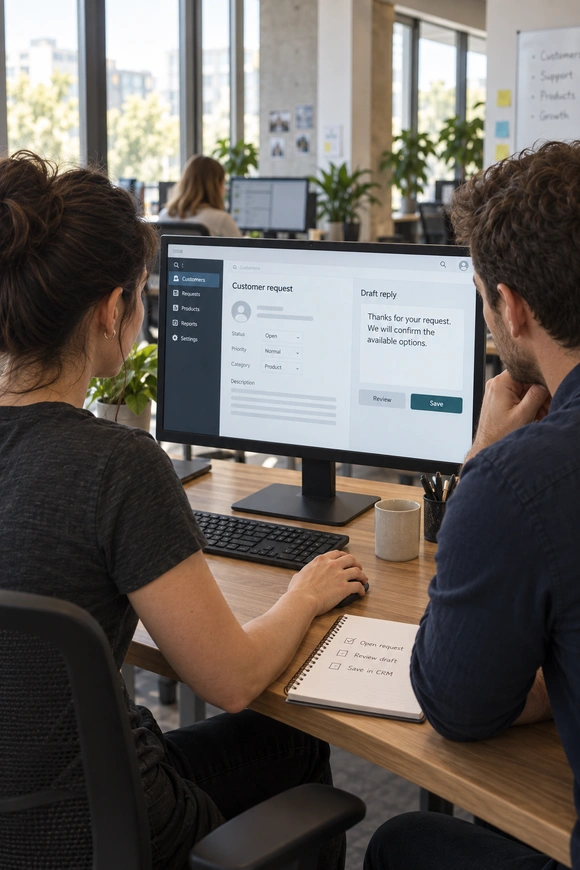
Start by observing a specific task and the information exchanged along the way. When handling a sales inquiry, for example, someone might check a customer's history in the CRM, review terms in another system and prepare a response. AI could gather that context and draft a reply within the same screen. Its value depends on how well it helps resolve the inquiry and how easily the person can verify and use the result.
That observation helps determine where the feature belongs. It might assist someone within an application, handle a step in a workflow or serve several tools. The choice affects the team's experience, the information available and ongoing maintenance. It may also reveal that a conventional integration would meet the need with less complexity. Start with the simplest suitable connection.
Agree on the information going in and the result coming back
Connecting systems requires a shared understanding of their data. A customer may have different identifiers, a status may carry different meanings and a date may refer to different events. Before using that information, the team needs to agree on the authoritative source for each field and preserve the context required to interpret it. Document these agreements for future changes.
Results need a defined structure as well. If AI proposes a classification or prepares an update, the receiving system should check that the fields are valid and the action is authorized. These checks help prevent a plausible response from automatically becoming an incorrect record. When information is missing, the workflow needs a way to complete or review the case.

Keep the process moving
Systems may become temporarily unavailable or take longer than expected to respond. An integration needs to account for those situations: what remains pending, how the user is informed and when another route is available. An assistance feature should allow people to continue work they could previously complete using the available tools.
It is also necessary to distinguish a failed request from a completed action whose confirmation never arrived. Repeating the request without checking can create duplicate records or repeated messages. Identifying each operation and retaining its status helps the team resume work safely. These operating decisions should be resolved before expanding the capability to more people or processes.
Introduce the capability progressively
An initial integration can retrieve information and prepare proposals for review. This makes it possible to evaluate usefulness, response times and exceptional situations without changing the entire workflow. The findings can then guide decisions about enabling additional actions, extending the feature to another team or improving the information it uses.
How we integrate AI into existing systems at 301
At 301, we combine process analysis with an understanding of existing systems. We examine how they can connect, define responsibilities and design an implementation the team can use and maintain. AI can then extend the value of previous technology investments and open new possibilities while preserving operational continuity. The implementation also lays the groundwork for future integrations.

Technology professional with over 25 years of experience in software development and technical team leadership for clients across the Americas, Europe, and Asia. Founded multiple tech ventures and led high-impact digital projects for leading brands in both corporate and startup environments. Specialized in system architecture, project management, and scalable digital solutions. Combines strategic vision, user experience focus, and technical execution to turn complex ideas into robust, sustainable products.