Software quality: what to protect as development accelerates
Let’s discuss the quality of your productAI tools can help prepare code, suggest tests and explore solutions during development. This creates opportunities to move forward with tasks that previously required more manual work. It also changes the team's balance: as producing a modification becomes easier, review and validation need to keep pace so the product retains its quality. Review capacity is part of delivery planning.
The question is how to establish that a change meets the need, works with the existing system and can be maintained after delivery. The answer involves shared criteria, product knowledge and evidence of actual behavior. An implementation that appears complete still needs to demonstrate that it works under the conditions that matter. The team needs a shared way to judge that evidence.
Agree on what successful delivery looks like
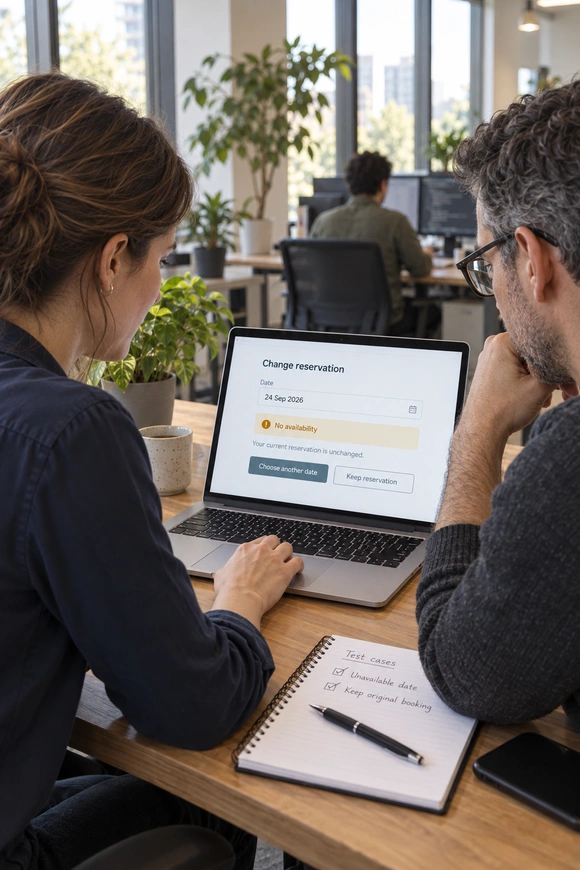
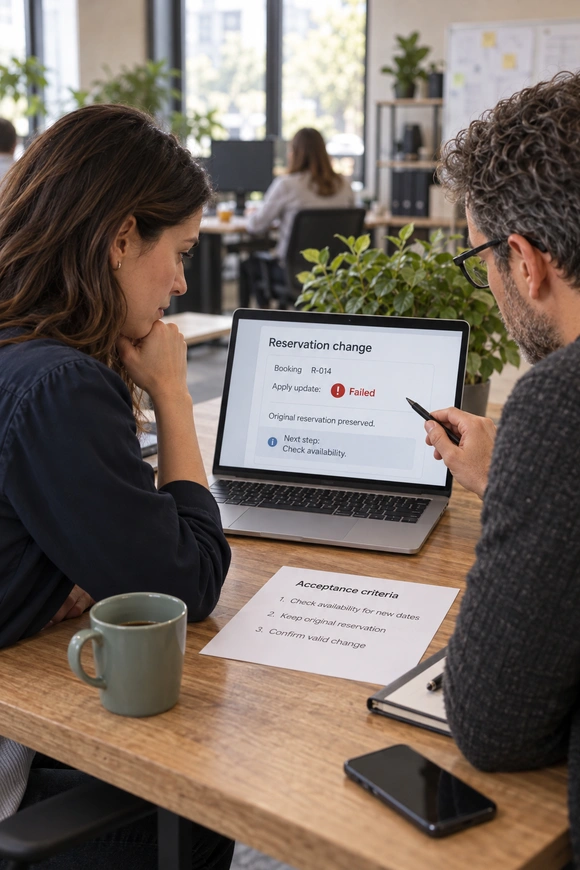
Quality begins with understanding the expected outcome. For a feature that changes a reservation, for example, saving the new date is only one requirement. The team must define what happens when availability is insufficient, who is allowed to make the change and how confirmation is communicated. Those agreements frame evaluation around the user journey and business rules.
AI can help suggest questions and scenarios from a functional definition. The team should check them with people who understand the operation, because a long list may still omit the condition that makes a process sensitive. Acceptance criteria need to express those decisions and provide a reference for both implementation and review.
Keep an independent view of the implementation
A useful review examines why code is organized in a particular way, which assumptions it makes and how it interacts with the rest of the system. When a tool generates a proposal, the team needs to retain the ability to explain it. Accepting a solution nobody understands makes investigation and later modification more difficult. Someone must be able to explain the design choices.
It is also useful to distinguish confidence in the implementation from confidence in its tests. If both start from the same mistaken interpretation, they can agree while leaving the problem undetected. Reviewing against independently defined criteria, business examples and expected outcomes introduces a different perspective on what has been built.
Use AI to broaden the exploration of cases
AI can help suggest data combinations, variations in a workflow or cases the team had not considered. Those suggestions need selection and review before becoming part of the tests. A large number of examples provides little assurance if they exercise the same behavior or check outcomes nobody has validated against the original need. Each test needs a meaningful expected outcome.
Effort should reflect the consequences of an error. Permission changes, operations affecting several records and integration updates may require particular attention. Combining automated tests with exploratory review helps examine repeatable behaviors alongside usability difficulties and situations that are not yet clearly described. Keep attention on the most consequential failures.
Keep evidence and learn from production use
A release needs information about what was reviewed, the results and known limitations. That evidence supports a clearer decision about readiness and the follow-up required. For a feature powered by AI, retaining representative examples also helps evaluate whether its outcomes remain useful after future modifications. That comparison should cover ordinary cases and exceptions.
How we integrate quality at 301
At 301, we integrate quality into definition, development and review. We use tools that contribute to the work while keeping delivery criteria clear. Usage information and incidents help us refine those practices. The ability to produce changes faster can then be matched by an equivalent ability to understand, verify and maintain what has been built.

Business executive with an MBA from IAE Business School and a background that spans over 12 years in the corporate world, entrepreneurship, and business consulting. Founded his own startup and has helped companies across industries align their real needs with effective digital solutions. Specialized in bridging business strategy with technology execution, supporting organizations throughout the entire product development process. Brings a business-first mindset, with a strong focus on impact, alignment, and long-term value.